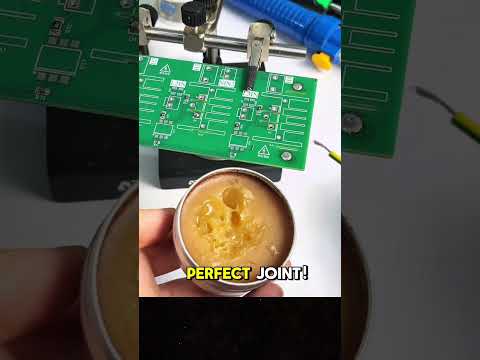
Unlock the secrets to mastering your soldering iron! Whether you’re a beginner or just brushing up, this video shares essential tips to improve your soldering skills. Learn about choosing the right soldering iron, handling techniques, and common mistakes to avoid. Perfect for hobbyists, electronics enthusiasts, and DIY lovers. Watch now to solder like a pro! 🛠️✨
Tags:
#solderingiron
#solderingtips
#solderingsecrets
#beginnersolderingguide
#howtousesolderingiron
#solderingmistakestoavoid
#solderingtutorial
#electronicssoldering
#DIYsoldering
#solderingforbeginners
#solderingironhacks
#solderingtools
#solderingtechniques
#electronicsrepairtips
#solderingbasics
#easysolderingtips
#howtosolder
#soldering
#solderingironuse
#howtosolderwires
#solder
#howtouseasolderingiron
#electronics
#basicsoldering
Someone once told me that solder flux is your friend! They are absolutely right!
You just soldered a wire on pcb bruh. If you do micro soldering that need high precision like 1mm then of course is very hard
Shit video!
Stupidest video I’ve ever seen on soldering. Dad taught me to solder on sheet metal back in the 1960s. Later, I became an electronics technician and had no trouble soldering. 1. Unless you have a through hole to put the wire into, you may need to tin the wire and the copper pad. But you do it quickly. You don’t play with the molten solder at either of those two locations. You apply it quickly and get off of it. Otherwise, you’ll oxidize the surface of the solder, and it will become stringy, as you can see in the video when he tins the copper pad. Next, you stick the end of the wire into the solder paste while it’s still hot, put it on the pad, and press it down with the hot iron. Immediately, the solder flows, and you get the iron OFF of it. Don’t stay on the joint with the iron, or, again, the solder with oxidize. Or, worse, the pad will come loose from the board if you heat it too long or too hot. If you’re quick with your tinning and don’t stay on it too long, you might not even need to stick the wire into the flux. 2. You CAN use a damp sponge, unless you leave the iron idling a long time at a high temperature. Only then, you might need something abrasive like a brass scrub pad. Otherwise, a wet sponge is fine. You just clean the iron on the pad like in the video, dragging it over the edge of the sponge, and tin it heavily like the guy did. Then, clean it again by rubbing it over the edge of the sponge, and LIGHTLY tin it, so you don’t have a ton of oxidized solder on the iron tip just waiting to corrupt the new solder of the joint. You only need enough to start heat conduction from the tip to the parts you’re going to solder. That will bring them up to the right temperature quickly. 3. If you have a through hole in the pad, you can put the wire in the hole and bend it on the back side so it stays put. Then, you just put the iron tip and the solder both onto the wire and pad at almost the same time – tip first, then solder, preferably between the iron tip and the part it is touching. Then, again, GET OFF! 4. Don’t move the joint until it solidifies. 5. Yes, solder goes where the heat is. So, it’s your job to put the heat where you want the solder to go – into the joint. But don’t overdo it! Use an iron of the proper wattage or a temperature adjustable soldering station, so you don’t burn everything up. And at the other end of the scale, “Don’t go to hell for soldering with a cold iron!”, as Dad used to say.
Use the right size and kind of solder. There is rosin core for electronics, in small diameters, 60/40 or 63/37 alloy. There are larger diameters for copper tubing and electrical wires. There’s even acid core. DO NOT use that on electronics or electrical wires! If you use it on pipes, neutralize it afterwards. There’s silver solder, lead free solder, and 95/5 air conditioning solder. There’s also bar solder for sheet metal, but you won’t be needing any of that, probably. 😅
Very well done. And I love your soldering helping hand on how you made it.❤❤❤