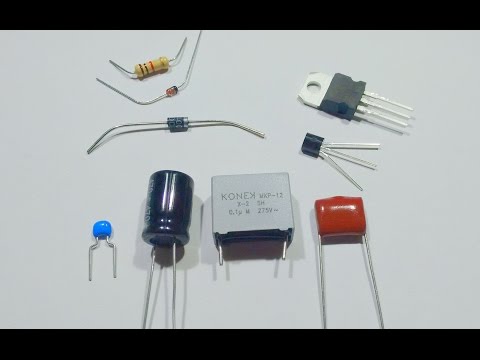
By request:- A basic guide to identifying components and their functions for those who are new to electronics. This is a work in progress, and I welcome feedback from you guys on whether I should break it down into more manageable chunks. I’ve kept the maths to a minimum, since it can be off-putting to someone just getting started in electronics.
The idea of this video is to slot in some more of the jigsaw pieces involved in learning electronics, when you start to recognise components, but aren’t quite sure what they are or what they do.
It’s tricky to squeeze even the basics into a single video, and I’ve just realised how long this one is (and why it took all night to upload).
If you enjoy my videos you can support the channel with a dollar for coffee, cookies and components at


Really interesting great video how do capacitors reduce noise
This reminds of buying a VU meter kit at radio shack. Worked perfectly
I miss that place.
I thought I was going insane during the diode explanation. I have a background in chemistry, so I know that electron donors are negatively charged and will flow into positively charge electron receptors. When I saw the flow through the diode going from positive to negative here and in tons of diagrams, I thought I was missing something and reality crumbled around me. Turns out it’s just a holdover from old days and it is just a positive “pressure” to negative, so the positive doesn’t equate to positive charge, but positive flow.
Edit: And never mind again. Zener diodes are supposed to let voltage in the wrong way? Which is… The opposite of what I thought diodes are supposed to do. And it somehow keeps the voltage constant.
Edit 2: I get it, now. I was thinking of it all being in-line and acting like a magic resistor, but instead it just acts as a kind of pressure safety valve so it makes a shortcut for voltages above the desired amount.
Edit 3: no clue what gain is supposed to be or what transistors are supposed to do, where the flow is going, or what it’s used for.
Edit 4: got it, now. Transistor is like a mouse trap. Once you overcome the pressure with a bit of power to the trigger, the more powerful spring gets released. The gain is the difference between the trigger strength and the main spring strength. A limit to how delicate the trigger can be for a powerful spring.
No registering, the tech talk is confusing..do you have the ” for dummies” version
Just came across this in 2025, the video is obviously delivered with passion, for beginners. Do you have any videos on SMDs?